How We Cleaned a Restoration Hardware Boucle Daybed in Far Hills, NJ — Without Damaging a Single Loop
Yes — a boucle sofa can be professionally cleaned with hot-water extraction, but only with a low-moisture method: a light prespray, gentle agitation, a plain-water rinse mist, and thorough vacuum extraction. We cleaned a 96-inch Restoration Hardware daybed in Far Hills this way, including a fiber-shaver step that removed trapped clothing fibers everyone thought were denim stains.
Boucle looks soft and inviting. It is also one of the hardest fabrics to clean well. The loops snag, the fabric watermarks, and if the cushions are feather-filled, one wrong move leaves them damp for days. We recently cleaned a Restoration Hardware Belgian Slipcovered Track Arm Daybed in Far Hills, New Jersey — a 96-inch by 60-inch piece in Performance Textured Boucle in Natural, with down-feather fill. Here is exactly how we did it, step by step.
The Piece: Restoration Hardware Belgian Slipcovered Track Arm Daybed
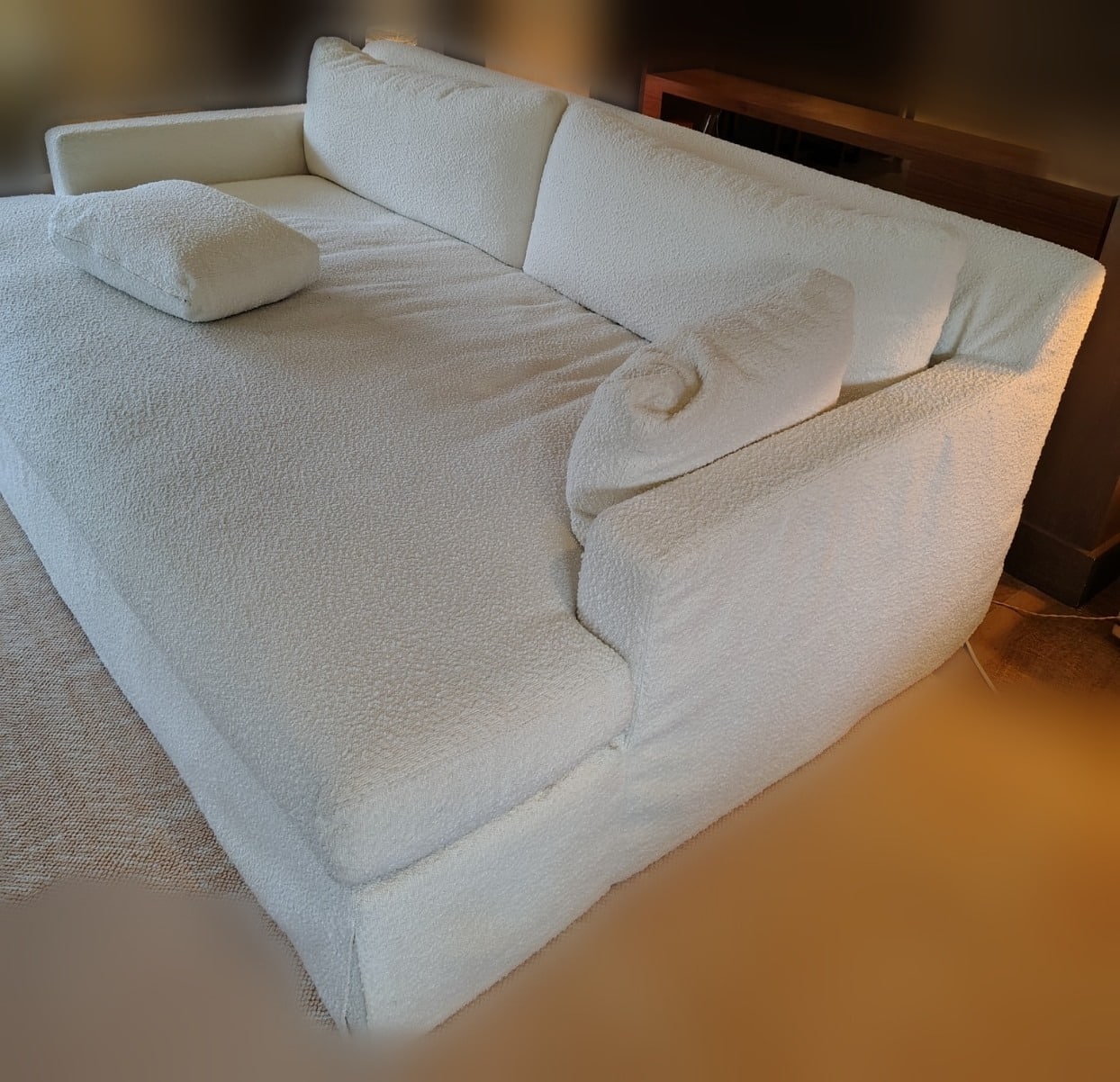
The daybed is from Restoration Hardware: 96 inches wide, 60 inches deep, 33 inches high, upholstered in Performance Textured Boucle in Natural, with down-feather filled cushions. It has five primary cushions — one large seat, two back cushions, two side cushions — plus the frame. The fabric had routine-use greying and a possible denim dye transfer.
The daybed before cleaning.
Why Is Boucle So Hard to Clean?
Looped yarns snag and pill. Anything with an edge — a stiff brush, a bare tool, high suction — hooks the loops.
Boucle watermarks easily. Uneven moisture leaves rings and stiffens the texture.
Feather and down fill dries extremely slowly. A soaked feather cushion can take 24 to 48 hours to dry, and damp fill clumps and smells musty.
Over-wetting is the number one mistake. The fix is low moisture, light application, and thorough extraction — pulling water out matters more than putting it in.
The Greyish Marks That Weren’t Stains
The customer had complained about greyish stains from routine use and thought they were denim transfer. When we looked closer, the boucle loops had caught darker fibers — most likely fibers shed from denim or other clothing, not dye transferred into the fabric. A stain treatment would not have fixed it. We used a fiber shaver to lift the trapped fibers out of the loops, and the fabric looked fresh again. It is a good reminder that on boucle, what looks like a stain is sometimes something caught in the loops — and diagnosing it correctly is half the job.
Agitating the prespray with a soft hand brush.
How Do Professionals Clean a Boucle Sofa?
Step 1 — Care labels first. We checked the care labels to confirm the piece could be cleaned with water. If a tag says S, X, or dry-clean-only, we stop and do not wet-clean.
Step 2 — Hidden tests. Before touching the visible fabric, we tested colourfastness, texture, and water reaction on a hidden area, plus a denim spotter test and a protector test. Nothing proceeds until the tests pass.
Step 3 — Floor protection. Two poly sheets went down around the daybed, with white towels on the side strips, all over the rug underneath. Cleaned cushions were staged on a separate white flat sheet — never on the sofa, never on the work sheet.
Step 4 — Dry vacuum and fiber shaver. The whole piece was vacuumed first on low suction: cushions, frame, seams, and crevices. Then a fiber shaver went over the greyish areas, lifting the trapped clothing fibers out of the boucle loops. The fabric looked fresh before any water touched it.
Step 5 — Prespray. Procyon Carpet & Upholstery Cleaner, misted evenly from the base of the upholstery going up. A light, even mist — enough to dampen the fabric, never enough to soak it.
Step 6 — Agitation. A soft hand brush worked the prespray in gently — light strokes, never scrubbing — right after spraying, while the fabric was still wet.
Step 7 — Dwell. Ten minutes, so the prespray could break down the soil. We worked one section at a time so no prespray dried before extraction.
Step 8 — Rinse. Plain water, applied as a light mist from a sprayer — never the extractor jet, which can distort boucle loops. One slow wet pass per section, no more.
Step 9 — Extraction. Thorough vacuum-only passes from the top going down, until the fabric is damp, not wet.
Step 10 — Cushion order. Back cushions first (feather fill dries slowest, so they get the most fan time), then side cushions, then the seat cushion, then the frame last. Each cushion was cleaned laying flat, both sides, then stood upright on the sheet to dry.
Step 11 — Protector. KleenGuard Choice fabric protector, applied while the fabric was still damp, only after the hidden test passed.
Step 12 — Drying. Air movers ran while we finished up and kept running to dry the piece, with the cushions separated for airflow.
Applying the prespray as a light, even mist.Drying with white towels.Towels laid across the seat while the piece dries.
What Should You Expect After a Boucle Cleaning?
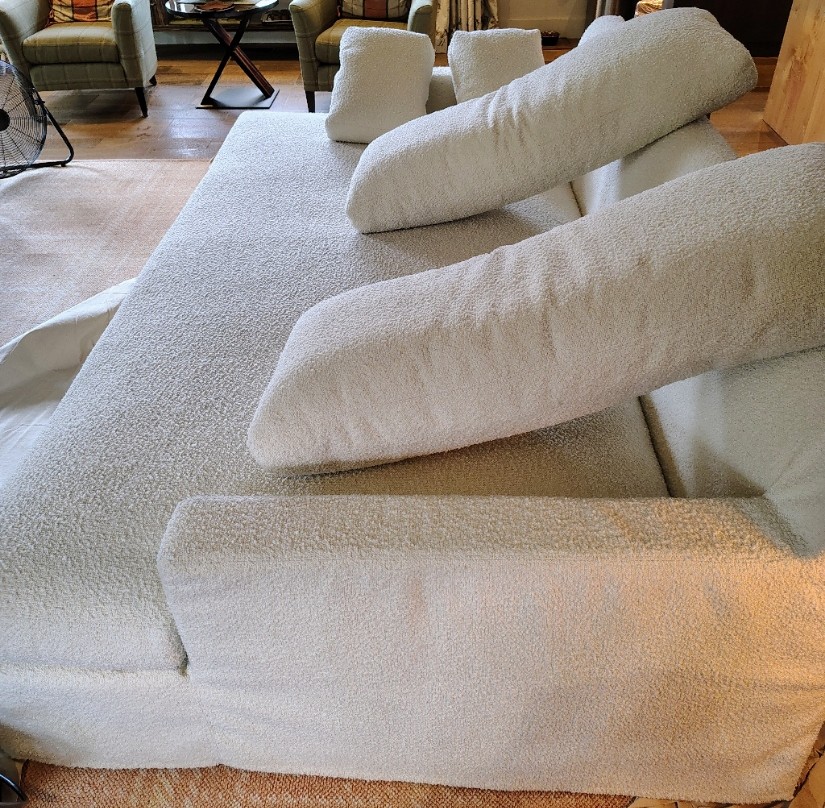
The daybed was left clean, protected, and drying with the air movers running.
The daybed after cleaning.
Frequently Asked Questions About Cleaning Boucle Sofas
Can boucle sofas be cleaned?
Yes. Boucle can be professionally cleaned with hot-water extraction, but only with a low-moisture method: light prespray, gentle agitation, a plain-water rinse mist, and thorough vacuum extraction. Flooding a boucle sofa or scrubbing it will damage the loops.
Can you use water on boucle?
Yes, if the care label allows wet cleaning. Check the label first — S and X codes mean solvent or dry-clean only, and water will damage those fabrics. For water-safe boucle, use a fine mist, never a soaking jet.
How long does a boucle sofa take to dry after cleaning?
Usually 4 to 12 hours with good airflow. Feather-filled cushions take longer — up to 24 to 48 hours if the fill gets wet through. Keep the room warm, run the HVAC fan, and separate the cushions so air reaches every surface.
What products are safe on boucle?
A soap-free, WoolSafe-certified prespray such as Procyon, applied at the upholstery dilution, with a plain-water rinse. Avoid harsh detergents, bleach, and stiff brushes. Always test on a hidden area first.
My boucle sofa has greyish marks — is it denim transfer?
Not necessarily. On our Far Hills job, the greyish marks looked like denim transfer but were actually darker clothing fibers caught in the boucle loops. A fiber shaver removed them and the fabric looked fresh. True dye transfer does happen, but on boucle, check for trapped fibers first — treating a fiber problem as a stain will not fix it.
How much does professional boucle sofa cleaning cost in New Jersey?
Premium upholstery is priced by custom quote, based on the size of the piece, the fabric, and its condition. A large boucle daybed takes more time and care than a standard sofa, and the price reflects that. Call (908) 521-8438 for a quote on your piece.
Should boucle be protected after cleaning?
Yes. A fabric protector such as KleenGuard Choice, applied while the fabric is still damp, helps the boucle resist future stains.
How often should a boucle sofa be professionally cleaned?
About once a year for a sofa in regular use, or every 12 to 18 months — the Carpet and Rug Institute’s guideline for carpeted homes. Clean more often if you have pets or kids, or if the piece sits in a high-traffic room.
Serving Far Hills and Northern New Jersey
Zoliks Cleaning serves Far Hills, Bernardsville, Bedminster, Mendham, Peapack-Gladstone, and more than 30 towns across northern New Jersey. We clean carpet, rugs, mattresses, upholstery, leather, curtains, tile and stone, countertops, air ducts, and dryer vents — all on site, with portable equipment. Call (908) 521-8438 or visit zolikscleaning.com.